
For more than two decades, I have watched enterprises repeatedly announce digital transformation, cloud adoption, DevOps journeys and now AI-first strategies.
Most of these efforts do not fail because of technology. They fail because the underlying system never changes.
Organizations modernize what they run, but not how they run it. They migrate workloads, but not accountability. They buy tools, but not operating models. They introduce governance, but not architecture-enforced control.
In regulated enterprises, especially banks and critical infrastructure organizations, the cost of getting this wrong is not just technical debt. It shows up as operational risk, audit exposure and systemic fragility.
The uncomfortable truth
Most large scale transformations look impressive in presentations and deeply fragile in reality.
On the ground, you typically find hundreds of teams each building their own version of “the right way”. You see dozens of landing zones, pipeline templates, security patterns and backup strategies. Security and risk operate as gates, not as embedded design. Reliability is treated as an operations problem. Cost is managed after the fact. And incident management depends on heroes.
On paper, everything looks modern. There is cloud, Kubernetes, CI/CD and observability. In reality, the estate is fragmented. The risk posture is opaque. The cost curve is unstable. And the organization survives on institutional memory and late nights.
This is not a cloud problem. It is a systems design problem.
The day you realize migration is not transformation
The biggest mental shift in any serious modernization effort is this. Migration is an activity. Transformation is a change in the operating model.
Moving workloads to the cloud does not make you cloud-native. Creating pipelines does not make you DevOps. Introducing SRE titles does not make you reliable.
Transformation begins when you stop thinking in terms of projects and start thinking in terms of products and platforms.
When we stopped building projects and started building platforms
In every large environment I have worked in, the inflection point came when we changed one question.
Instead of asking “How do we migrate this estate?”, we started asking “What platforms must exist so that migration becomes boring?”
That single shift changes everything. Cloud foundations become a product. Engineering systems become products. Data platforms become products. Reliability becomes a feature. Governance becomes architecture.
And products have owners, roadmaps, adoption metrics, service levels, cost models and clear accountability. This is the moment when scale becomes possible without chaos.
The enterprise platform transformation system
Over time, a clear mental model emerged for me. Transformation is not a sequence of initiatives. It is a system of reinforcing platforms, controls and operating models.
I represent this as a layered model that I call the enterprise platform transformation system. At the bottom is the cloud and hybrid foundation. On top of that sits platform as product. Above that is governance by design. Then reliability engineering. At the top sits outcome driven management. Across all layers runs the reality of regulated enterprise controls. Underneath everything sits the operating model and leadership system.
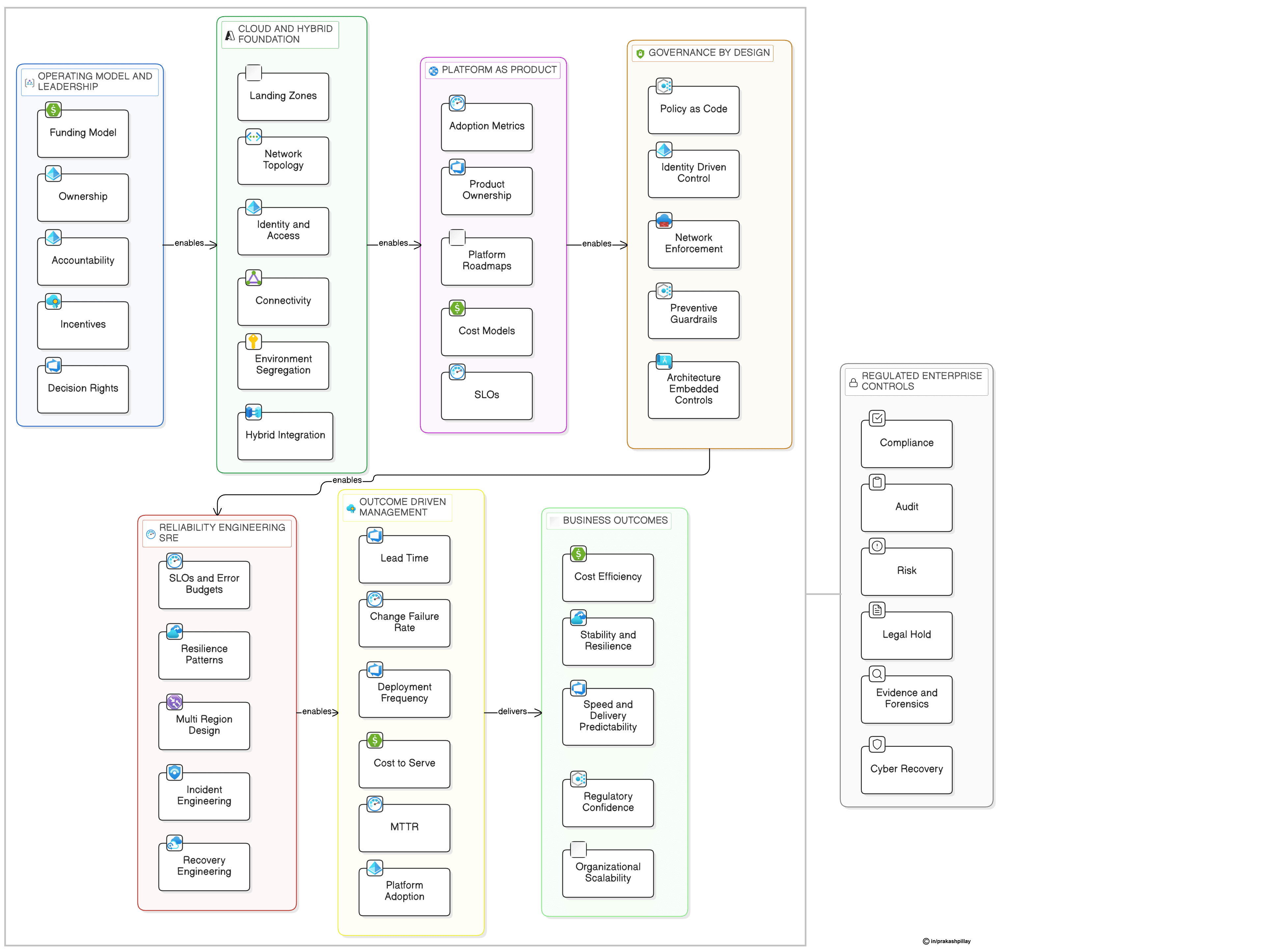
The five non negotiable systems
1. A real cloud and hybrid foundation
Not “some subscriptions and some networks”. A real foundation means deliberate network topology, identity as the control plane, environment segregation by design, private connectivity, policy and guardrails baked in, and hybrid treated as a first class citizen.
If your foundation is not boring, your future will not be stable.
2. Platforms must be products
The moment you hear “this is a shared service, teams can use it if they want”, you already lost.
Platforms must have product ownership, experience KPIs, adoption targets, reliability objectives and clear contracts. Otherwise they become cost centers, political negotiation layers or are simply bypassed.
3. Governance must be designed, not approved
Approval based governance does not scale. It creates delay, theater and eventually shadow IT.
Real governance looks like policy as code, identity driven control, network level enforcement and platform guardrails. It is architecture that makes the wrong thing impossible.
The best governance is the one nobody needs to ask permission for.
4. Reliability is an engineering property
If SRE is a team, you have misunderstood SRE. Reliability must be designed into platforms, tested continuously and measured relentlessly.
In environments where this was done properly, major incidents reduced materially, mean time to recovery improved dramatically, change failure rates dropped and critical platforms crossed four nines of availability.
Not because people worked harder. Because the system was designed better.
5. Outcomes are the only strategy that matters
If you do not run your transformation using metrics like deployment frequency, lead time, change failure rate, mean time to recovery, platform adoption and cost to serve, then you are not running a strategy. You are running a belief system.
Every serious platform organization I have built eventually moved to outcome driven management. Everything else is storytelling.
The regulated enterprise reality
In banks and regulated institutions, you do not just need recovery. You need cyber recovery. You need legal hold. You need forensic evidence. You need provable controls. You need auditable operations.
“Move fast and break things” is not innovation here. It is negligence.
True resilience means separating operational recovery from cyber recovery, separating archival from restore, designing for jurisdictional isolation and assuming compromise is not hypothetical. This is not optional architecture. It is fiduciary responsibility.
What actually changed when we did this properly
Before this shift, every major incident was a war room. Recovery was heroic. Outcomes were uncertain.
After this shift, most incidents became non events. Recovery became predictable. Audit conversations changed from defense to evidence. Cost became a design variable, not a surprise. Teams moved faster, not slower.
Most importantly, the organization became structurally safer.
If I were starting again tomorrow
I would invest in foundations before migrations. I would kill customization early. I would enforce platform adoption unapologetically. I would design governance into architecture from day one. I would build reliability into engineering culture, not as a team. And I would measure only what actually changes behavior.
The real definition of transformation
Transformation is not when you move to the cloud. It is not when you launch a platform. It is not when you declare success.
Transformation is when the organization cannot go back. When the old way becomes structurally impossible. When the new way becomes boring. When reliability, security, governance and speed are properties of the system, not acts of heroism.
That is not a technology change. That is a leadership decision.
Closing thought
After more than twenty years inside large enterprises, I no longer believe in digital transformation programs.
I believe in building systems that force good behavior. Everything else is just PowerPoint.